
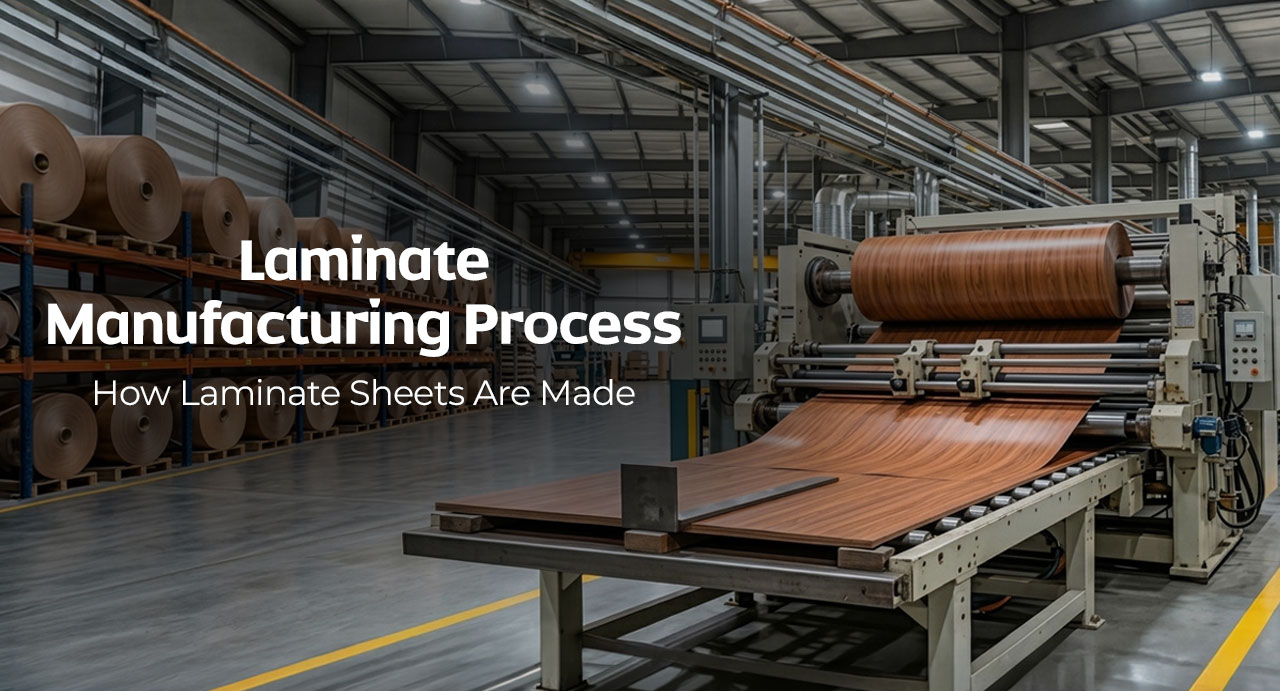
The laminate manufacturing process involves converting layers of specially treated paper into a durable, decorative High-Pressure Laminate (HPL) sheet using thermosetting resins, controlled heat, high pressure, and precision processing. From raw-material selection and resin impregnation to layering, hydraulic hot pressing, cooling, testing, and final finishing, every stage is carefully controlled to achieve the required surface quality, strength, dimensional stability, and durability.
The process begins with kraft, decorative, and overlay papers, which are treated with resin and prepared for assembly. These resin-impregnated layers are then precisely arranged and consolidated in hydraulic hot presses, where heat and pressure transform the paper stack into a dense, integrated HPL sheet. The finished laminate is subsequently cooled, stabilized, inspected, and precision-cut before packaging.
This guide explains how laminates are made, step by step, with a detailed look at the materials, resin system, paper layering, hot-pressing process, quality testing, and finishing involved in modern HPL manufacturing.
Step-by-Step Laminate Manufacturing Process
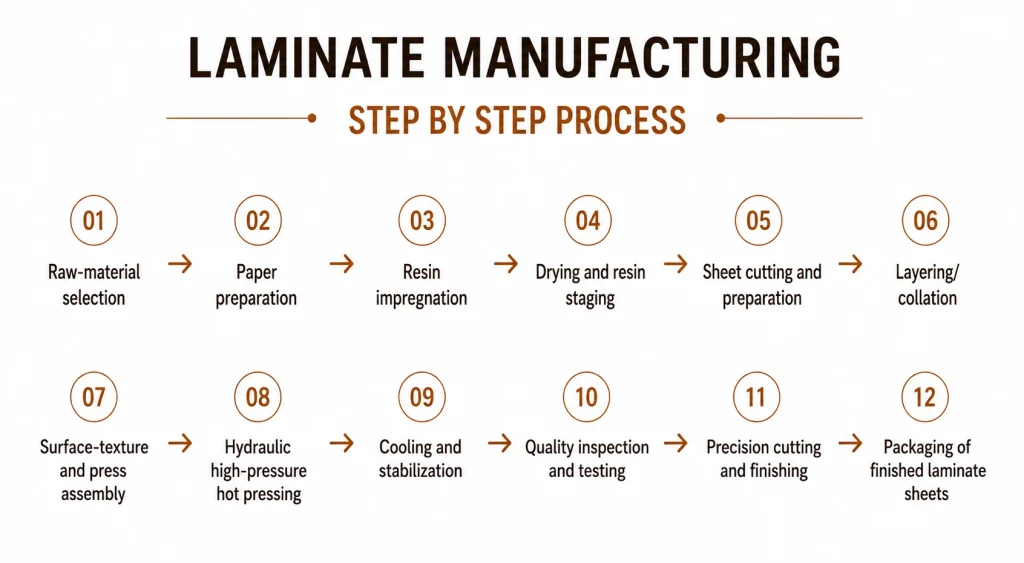
1. Selection of Raw Materials
The laminate manufacturing process begins long before the sheets enter a hot press. The quality and consistency of the incoming raw materials influence everything that follows. The raw materials used in conventional decorative high pressure laminates (HPL) production are:
- Kraft paper: Kraft paper forms the main structural core of a typical laminate. Multiple layers are used, and the paper is impregnated with a thermosetting resin before pressing. The kraft layers provide much of the sheet’s thickness, mechanical integrity, and dimensional structure.
- Decorative paper: Decorative paper carries the visual identity of the laminate. It may reproduce woodgrains, stone, marble, textiles, solids, abstracts, or other design patterns. The quality of the print matters because any inconsistency in colour, pattern, or surface preparation becomes visible in the finished laminate.
- Overlay paper: A thin protective surface layer is commonly used over the decorative paper in standard decorative HPL construction. After curing, this contributes to the hard, wear-resistant surface of the laminate.
- Thermosetting resins: Resins are what transform specially selected papers into a high-performance laminate material. In conventional HPL production, phenolic resin is associated primarily with the kraft-paper core, while melamine-based resin is commonly associated with the decorative surface system. Ogaan Laminates emphasizes a 100% phenolic laminate construction, while the decorative papers are impregnated with high-grade phenolic and melamine resins.
2. Paper Preparation Before Impregnation
Paper used for HPL production is not simply placed into a press in its original condition. The rolls or sheets must first be prepared for controlled resin treatment. The paper’s basis weight, absorbency, moisture condition, surface quality, width, and physical consistency all matter because they influence resin uptake, handling, layer uniformity, and the consistency of the finished laminate.
This is especially important for kraft paper because the paper does double duty: it acts as a reinforcement before pressing and becomes part of the consolidated thermoset structure afterward. The decorative paper requires equally careful handling because it ultimately determines the visible appearance of the laminate.
3. Resin Impregnation: Preparing the Paper for Laminate Production
The next major stage in the laminate manufacturing process is resin impregnation. The basic principle is straightforward: absorbent paper is passed through a resin system so that the resin penetrates the paper structure rather than remaining only on the surface.
For the kraft core, phenolic resin is commonly used. Decorative and overlay papers are commonly treated with a melamine-based resin system in conventional HPL production.
Too little resin can compromise consolidation and performance. Too much or improperly staged resin can create processing problems during pressing. This is why impregnation is one of the most technically important stages in the laminate manufacturing process.
4. Drying and Resin Staging
After impregnation, the paper cannot immediately be treated as a finished laminate component. The impregnated material is dried under controlled conditions so that part of the resin reaction occurs before the final pressing stage. In industrial terminology, this partially advanced condition is often described as the B-stage.
The goal is not to completely cure the resin at this point. Instead, the treated paper needs to become sufficiently stable for:
- Handling
- Cutting
- Stacking
- Storage for the Appropriate Production Window
- Consolidation in the Hot Press
At the same time, enough reactive potential must remain for the resin to soften, flow, consolidate the paper layers, and complete its thermosetting reaction during pressing. Technical descriptions of HPL production identify impregnation, drying/staging, assembly, pressing, and finishing as distinct manufacturing stages.
5. Cutting and Preparation of Treated Papers
Once the impregnated papers have reached the required condition, they are prepared for assembly. Depending on the manufacturing line, treated materials may be converted from continuous rolls into individual sheets of the required dimensions. This is where production accuracy starts becoming directly visible in the finished product.
The sheets must be:
- Correctly Sized
- Free from Unacceptable Defects
- Properly Oriented
- Ready for Precise Stacking
At Ogaan Laminates, the standard sheet size is 1220 × 2440 mm (8 × 4 ft) across the product range, while door skin is also available in additional sheet-size variants.
6. Layering and Collation: Building the Laminate Structure
The next stage is collation, also called lay-up or assembly. This is where individual treated papers are placed in a defined sequence to create the laminate package.
A typical decorative HPL structure can be understood from top to bottom as:
Protective overlay
↓
Decorative paper
↓
Multiple resin-impregnated kraft-paper layers
The decorative paper determines the visual design. The overlay protects the visible surface. The kraft-paper layers create the principal core structure. The exact paper construction can vary by product type, thickness, finish, and performance requirement.
Laminate manufacturers alter the number and characteristics of the core layers rather than producing every thickness from an identical paper stack.
7. Surface Texture Is Created During Pressing
One of the most important parts of HPL manufacturing is that the laminate’s texture is not necessarily achieved only through post-processing. Specially prepared press plates or textured steel plates can transfer a surface structure to the laminate during thermo-lamination.
This is how finishes can move beyond a simple printed image toward tactile surfaces such as:
- Woodgrain
- Matt Textures
- Stone Effects
- Fabric-Like Textures
- Gloss Surfaces
- and Deeper Embossed Patterns
Technical specifications of HPL manufacturing identify press plates as part of the thermo-lamination assembly, with the surface of the press system influencing the final laminate finish. This makes pressing both a structural and an aesthetic operation. The press does not simply bond the layers. It helps determine how the finished surface looks and feels.
8. Hydraulic High-Pressure Hot Pressing
This is the central stage of the HPL manufacturing process. The assembled laminate package is placed into a hydraulic hot press. Heat and pressure are applied simultaneously to consolidate the resin-treated paper layers into one dense, integrated sheet.
The heat activates the thermosetting resin system. The pressure brings the layers together, encourages consolidation, and allows the resin to flow through the structure before the final cure. HPL production uses pressures of over 800 PSI and temperatures above 140°C; the exact production cycle depends on the laminate construction, resin system, equipment, press plates, and product requirements.
Industrial production uses multi-opening or multi-daylight hydraulic presses, allowing many laminate packages to be processed within one press cycle. This increases production efficiency while maintaining controlled pressure and temperature across the press stack.
Ogaan Laminates produces high-pressure laminates through a process centered on hydraulic hot pressing. Our manufacturing facility covers approximately 1 lakh sq. ft. and is equipped with two 16-daylight hot-press machines, with a stated capacity of up to 2.6 lakh HPL sheets per month.
9. Cooling and Stabilization After Pressing
Pressing does not mark the end of the laminate manufacturing process. Once the thermosetting cycle has been completed, the laminate must be cooled and stabilized. This stage helps the sheet achieve dimensional consistency before final handling and sizing. Cooling is especially important because a newly pressed laminate has passed through substantial changes in temperature and internal stresses.
A sheet that is dimensionally unstable at this stage may develop problems later during fabrication or installation. Ogaan Laminates specifically identifies cooling and stabilization as part of its manufacturing sequence, with dimensional accuracy and long-term performance as the objectives.
10. Precision Cutting and Final Finishing
Once the laminate has been cooled, stabilized, and inspected, the sheets move into final preparation.
Final sizing must maintain:
- Dimensional Accuracy
- Clean Edges
- Consistent Sheet Geometry
- Correct Thickness
- and Acceptable Visual Quality
Depending on the product and manufacturing system, industrial HPL production may also include additional finishing operations such as back sanding or other surface preparation before packaging. The important point is that final finishing is about converting the pressed material into a consistent, usable commercial laminate sheet.
Every stage has a specific purpose. A problem in one stage can affect the appearance or performance of the final sheet, which is why HPL manufacturing is fundamentally a process-control exercise rather than a single pressing operation.
Quality Control Is Not a Single Final Inspection
A high-quality laminate manufacturing process does not rely exclusively on inspecting the finished sheet. Quality has to be controlled throughout production.
Ogaan Laminates states that it carries out quality checks throughout production and identifies three broad areas of control:
- Resistance tests
- Stability tests
- Visual tests
Together, these checks create a more reliable approach to quality by evaluating not only how a laminate looks, but also how consistently it performs and remains stable during use. Quality control is therefore not simply a final checkpoint. It is a continuous process that helps ensure the finished laminate delivers the expected levels of appearance, durability, and performance.
What Is Tested in a Laminate Sheet During the Manufacturing Process ?
HPL performance is evaluated through standardized tests covering properties such as appearance, surface wear, impact, scratching, heat, water resistance, dimensional stability, steam, and other characteristics. ISO 4586-2 defines standardized test methods for HPL properties.
Surface wear resistance
Surface wear testing evaluates how well the decorative surface resists abrasive wear. The test uses controlled abrasive loading and measures the number of revolutions associated with defined wear endpoints.
Scratch resistance
Scratch testing evaluates how much applied load the surface can resist before a defined continuous scratch is produced.
Impact resistance
Impact testing evaluates the laminate’s ability to withstand localized impact without unacceptable damage.
These tests evaluate how the laminate responds to exposure to boiling water and moisture, including changes in mass, thickness, appearance, and structure.
Dimensional stability
A laminate must maintain its dimensions within acceptable limits when exposed to specified environmental conditions. This matters because uncontrolled dimensional movement can contribute to fabrication problems, joint issues, or surface distortion.
Heat resistance
Heat-resistance testing examines how the decorative surface responds to controlled heat exposure.
Visual inspection
The finished surface is inspected for appearance and defects. This is especially important for anti fingerprint laminates, where surface uniformity, finish consistency, and resistance to visible marks contribute to the overall appearance.
Ogaan Laminates: Technical Performance
| Properties | Test Results of Ogaan Laminates |
|---|---|
| Resistance to Surface Wear (Revolution Minimum) | ≥ 375 Rev |
| RESISTANCE TO IMERSION IN BOILING WATER MASS INCREASE (%) | 7.5% (Max) |
| RESISTANCE TO IMERSION IN BOILING WATER THICKNESS INCREASE (%) | 8.5% (Max) |
| Resistance to Dry Heat at 180°C Gloss | Rating-4 |
| Resistance to Dry Heat at 180°C OTHERS | Rating-5 |
| Dimensional Stability at Elevated Temperature (%) Machine Direction | 0.42% |
| Dimensional Stability at Elevated Temperature (%) Cross Direction | 0.70% |
| Resistance to Impact by Small-Diameter Ball | 25 N |
| Resistance to Cracking | Rating-5 |
| Resistance to Scratching (Min) | 2.4 N |
| Resistance To Staining GROUP 1 & 2 | Rating-5 |
| Resistance To Staining GROUP 3 & 4 | Rating-4 |
| Resistance to Cigarette Burns | Rating-4 |
| Resistance to Steam | Rating-5 |
| Appearance | No ABC Defects |
Note: Technical performance may vary across different product categories. Products such as door skin and acrylic laminates may have different performance parameters and specifications.
Conclusion
The laminate manufacturing process is a carefully controlled sequence in which specially selected papers are transformed into a durable decorative HPL surface through resin impregnation, staging, precision layering, hydraulic hot pressing, cooling, testing, and finishing.
Every part of the process serves a purpose.
- The paper determines the foundation.
- The resin enables consolidation and curing.
- The layer arrangement creates the structure.
- The press consolidates and cures the layers while transferring the required surface character.
- Cooling establishes stability.
- Testing verifies performance.
- Precision finishing prepares the final sheet for fabrication.
At Ogaan Laminates, this process is carried out through its HPL manufacturing setup, supported by hydraulic multi-daylight hot-pressing equipment and continuous quality controls. Ultimately, the finished laminate sheet is the result of much more than a decorative pattern. It is the outcome of controlled materials, controlled chemistry, controlled layering, controlled pressure and temperature, and controlled quality at every stage. That is what makes modern HPL manufacturing both a material science and a precision manufacturing process.
 Laminates Business