
Choosing the right laminate involves more than selecting the perfect design, color, texture, and finish. Selecting the appropriate laminate thickness is equally important, as different thicknesses are designed for different applications, each offering its own balance of durability, performance, flexibility, and cost. Choosing the right thickness ensures the laminate meets the functional and aesthetic requirements of your project.
Whether you’re selecting laminates for wardrobes, modular kitchens, office furniture, wall panels, or retail interiors, understanding the available laminate sheet thicknesses helps you choose the most suitable option for your application, balancing durability, appearance, and long-term performance.
As a leading laminate manufacturer with over three decades of experience in manufacturing decorative laminates, Ogaan Laminates understands how laminate specifications influence the durability, performance, and suitability of different interior applications. Based on practical manufacturing expertise and common application requirements, this guide explains the available laminate thickness options and standard laminate sheet size, helping you select the right laminate for every project.
Understanding Laminate Thickness
Laminate thickness refers to the depth of a laminate sheet from one surface to the opposite surface, usually measured in millimetres (mm). It directly influences the strength, durability, and suitability of the laminate for different interior applications.
Generally, thicker laminates provide greater impact resistance and durability, making them suitable for high-traffic areas. Thinner laminates are commonly used for internal surfaces and decorative applications where heavy wear is not expected.
Laminate sheet thickness directly influences impact resistance, structural stability, edge strength, and long-term durability, making it one of the most important considerations when selecting decorative laminates. That’s why it’s important to know about the types of laminates based on thickness before choosing the right laminate for your project.
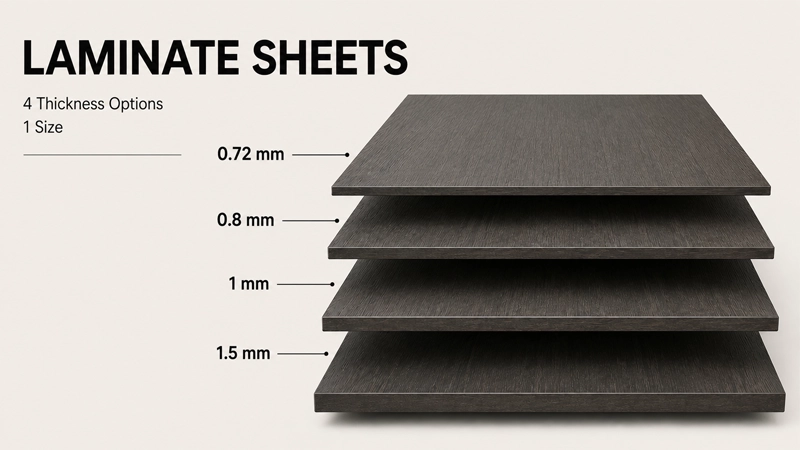
0.72mm Laminate Thickness
A 0.72mm laminate is commonly known as a liner laminate and is primarily used as an internal finishing surface for furniture. It is designed for cabinet interiors, wardrobes, drawers, back panels, shelves, and other concealed areas where a clean, uniform appearance is required. As one of the thinnest decorative laminate options, it provides an economical and aesthetically consistent finish for interior furniture surfaces. However, it is not intended for exterior applications or surfaces exposed to frequent wear and heavy use.
0.8mm Laminate Thickness
0.8mm is the standard laminate thickness used for most furniture and interior surfaces in residential and commercial spaces. Designed for everyday applications, it provides a reliable balance of durability, affordability, and ease of installation. 0.8mm laminate is ideal for surfaces that experience regular use without being exposed to excessive moisture, impact, or abrasion.
Common applications include:
- Wardrobes
- Bedroom furnitures
- Office desks and workstations
- Hotel and hospital furniture
1mm Laminate Thickness
The 1mm thick laminate offers enhanced strength and durability, making it ideal for surfaces exposed to frequent use, moisture, and regular cleaning. It is particularly well-suited for modular kitchens, countertops, workstations, and other high-contact interior applications. The increased thickness also allows for deeper embossed textures, creating more realistic woodgrain, stone, and tactile surface finishes.
Common applications include:
- Kitchen cabinets and shutters
- High-use residential furniture
- Commercial interiors
- Moisture-prone areas requiring greater durability
1.5mm Laminate Thickness
The 1.5mm laminate thickness is widely used for premium interior applications that require both durability and a refined appearance. It is suitable for modular kitchens, wardrobes, furniture, and commercial spaces where a high-quality surface finish is desired. Ogaan Laminates offers acrylic laminates in 1.5mm thickness and mirror-like high gloss finish, providing rich color depth, a smooth surface, and reliable everyday performance for a wide range of interior applications.
Standard Laminate Sheet Size
The standard laminate sheet size is 8ft × 4ft (1220mm × 2440mm), which is widely compatible with standard plywood, MDF, and particle board dimensions. This industry-standard size helps minimise material wastage, simplifies fabrication, and ensures efficient installation across a wide range of furniture and interior applications.
An 8ft × 4ft laminate sheet is ideal for:
- Modern wardrobes
- Modular kitchen cabinets
- Study tables and office desks
- Wall panels and partitions
- Commercial counters and furniture
One of the key advantages of this sheet size is its ability to cover large surfaces with minimal or no visible joints. This creates a seamless appearance while preserving the continuity of woodgrain, stone, marble, fluted, floral, and other decorative patterns. Ogaan Laminates offers its laminate sheets in this standard size to ensure compatibility with modern furniture manufacturing and interior design requirements.
Quick Reference: Laminate Thickness by Application
Different laminate sheet thicknesses are designed for different interior applications. While thinner laminates are commonly used for internal surfaces, thicker laminates offer greater durability for furniture, kitchens, and other frequently used areas.
The table below provides a quick overview of the most commonly used thickness options of laminates, their typical uses, and where they perform best.
| Laminate Thickness | Type | Common Applications | Best Suited For |
|---|---|---|---|
| 0.72mm | Liner Laminate | Cabinet interiors, back panels, decorative lining | Low-contact internal surfaces |
| 0.8mm | Standard HPL Laminate | Wardrobes, bedroom furniture, office furniture | General residential and commercial interior use |
| 1mm | High-Durability HPL Laminate | Kitchen cabinets, Wall panels, dining tables, and daily-use furniture | High-use areas |
| 1.5mm | Acrylic Laminate | Premium kitchens, wardrobes, and commercial interiors | High-impact, premium applications |
Choosing the Right Laminate Thickness Based on Application
While understanding laminate sheet thickness options is important, choosing the right thickness also depends on where the laminate will be used. Different areas of a home or commercial space experience different levels of wear, moisture, and daily use, making application-specific laminate selection essential.
Laminate Thickness for Wardrobes
For most wardrobes, a 0.8mm laminate thickness provides the right balance of durability, appearance, and cost-effectiveness. However, wardrobes that are opened and closed frequently or used in high-traffic spaces can benefit from a 1mm thick laminate, which offers additional strength and improved resistance to everyday wear.
Laminate Thickness for Furniture
When selecting laminate sheet thickness for furniture, usage should be the primary consideration. Standard furniture such as study tables, storage units, bedroom furniture, and office workstations generally perform well with 0.8mm laminates. For furniture that experiences frequent use, a 1mm laminate offers greater durability and a longer service life.
Laminate Thickness for Kitchen Cabinets
Kitchens are exposed to moisture, regular cleaning, and constant daily activity. For this reason, both 1mm and 1.5mm laminate thicknesses are commonly recommended for kitchen cabinets and shutters. Compared to thinner laminates, they provide better durability and help maintain the appearance even in demanding environments.
Thickness, Design & Substrate: Getting the Foundation Right
Choosing the correct laminate thickness is only part of the process. The quality of the substrate beneath the laminate is equally important. A flat and stable base, such as quality plywood or MDF, helps ensure proper bonding and a smooth finish.
It is also important to consider the laminate sheet size when planning your design. Proper sheet planning helps minimise visible joints and allows patterns such as wooden, marble, floral, fluted, and stone designs to flow more naturally across the surface.
HPL vs LPL: Why Laminate Manufacturing Type Matters
While laminate thickness is important, the manufacturing process also plays a key role in determining how well a laminate performs over time. High Pressure Laminates (HPL) are manufactured by compressing multiple layers of resin-impregnated kraft paper, decorative paper, and overlay sheets under high pressure and temperature.
The final laminate sheet thickness is determined by the number of kraft paper layers used, creating a dense, durable surface suitable for furniture, wardrobes, kitchens, and other frequently used interior applications. Choosing the right high pressure laminate thickness further enhances durability and ensures reliable performance in residential and commercial spaces.
In contrast, Low Pressure Laminates (LPL) are typically used for lighter applications and may not offer the same level of durability and wear resistance as HPL. At Ogaan, all laminates are manufactured as High Pressure Laminates (HPL), providing durable surfaces that maintain their appearance and performance for years of everyday use.
Conclusion
Choosing the right laminate thickness is key to achieving long-lasting and visually appealing interiors. Use 0.72mm liner laminate for internal and decorative lining work, 0.8mm thickness for general furniture applications, 1mm thick laminate for kitchens and high-use residential areas, and 1.5mm acrylic laminate for premium, high-impact spaces that demand both durability and a rich finish. Matching the right thickness with the right application ensures better performance, lower maintenance, and a more refined final look.
 Laminates Business