
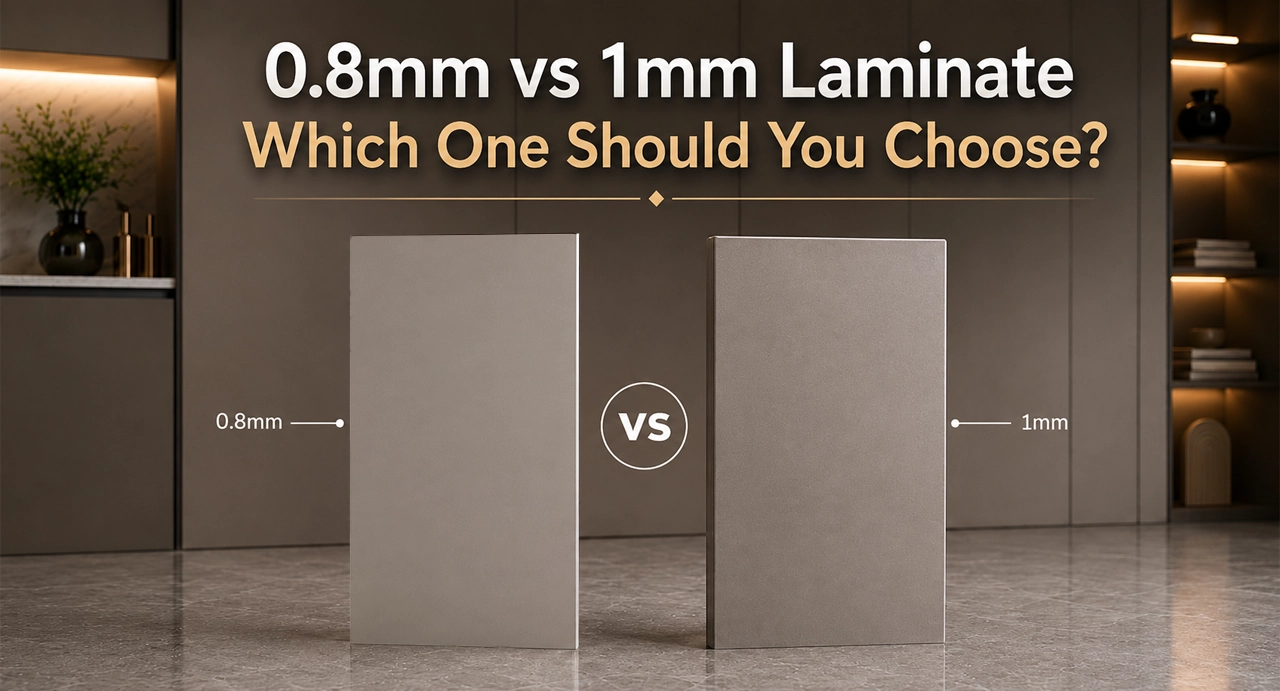
When choosing decorative laminates, one of the most common questions homeowners, architects, and interior designers ask is which one is the better choice – 0.8mm vs 1mm laminate? While both thicknesses offer attractive finishes and are widely used for furniture and interior applications, they differ in durability, impact resistance, and cost. The right choice depends on where the laminate will be installed, how frequently the surface will be used, and the level of durability required.
The quality of a laminate directly influences its performance and durability, alongside its thickness. Therefore, choosing a trusted laminate manufacturer is equally important to ensure long-lasting quality, reliability, and consistent performance. This guide explains the difference between 0.8mm and 1mm laminate, helping you select the most suitable option for your project.
Understanding 0.8mm and 1mm Laminates
Decorative laminates are commonly available in both 0.8mm and 1mm thicknesses, with each designed to suit different functional requirements. While both offer the same range of colors, finishes, and textures, the difference in thickness influences their durability, strength, and ideal applications. Understanding the characteristics of each laminate thickness makes it easier to choose the right surface for your furniture and interior spaces.
0.8mm Laminate: Applications and Benefits
The 0.8mm laminate is standard for most interior applications because it provides an acceptable balance between visual appeal, performance, and cost. It is one of the most common laminate options for residential and commercial furniture due to its ability to resist moderate pressure and significant deformation. It is well-suited for surfaces that receive normal daily use without excessive impact or heavy loads.
Common Applications of 0.8mm Laminate
- Wardrobes
- Bedroom furniture
- TV units
- Wall panelling
- Cabinets
- Display units
- Office furniture
- Shelving
Advantages of 0.8mm Laminate
- Cost-effective for large projects
- Wide range of colors, textures, and finishes
- Easy to fabricate and install
- Suitable for most decorative interior furniture
- Reliable performance for residential spaces
1mm Laminate: Applications and Benefits
The 1mm laminate is preferred for applications that require enhanced durability and long-term performance. Its additional thickness improves structural strength and resistance to scratches, impacts, and everyday wear, making it well-suited for surfaces that experience frequent use. It offers a reliable balance of aesthetics and performance for both residential and commercial interiors where greater durability is a priority.
Common Applications of 1mm Laminate
- Kitchen cabinets
- Countertops and work surfaces
- Dining tables
- Office workstations
- Commercial furniture
- Reception desks
- Frequently used wardrobes
Advantages of 1mm Laminate
- Better impact resistance
- Improved scratch and abrasion resistance
- Wide range of colors, textures, and finishes
- Enhanced durability in high-traffic areas
- Greater resistance to daily wear
- Longer service life under demanding conditions
Technical Specifications: 0.8mm vs 1mm Laminate
| Specification | 0.8mm Laminate | 1mm Laminate |
|---|---|---|
| Nominal Thickness | 0.8mm | 1.0mm |
| Thickness Tolerance | ±0.05mm | ±0.05mm |
| Standard Sheet Size | 1220 × 2440mm (8 × 4 ft) | 1220 × 2440mm (8 × 4 ft) |
| Composition | Decorative paper + overlay + phenolic resin-impregnated kraft paper core | Decorative paper + overlay + additional phenolic kraft paper core |
| Core Structure | Multiple kraft paper layers | More kraft paper layers than 0.8mm, resulting in a denser core |
| Surface Wear Resistance | Excellent | Excellent to Superior |
| Scratch Resistance | Good | Higher |
| Abrasion Resistance | Good | Higher |
| Impact Resistance | Moderate | High |
| Edge Stability | Good | Better edge retention with reduced chipping during fabrication |
| Dimensional Stability | Excellent | Excellent |
| Resistance to Dry Heat | Complies with EN 438 requirements (typically tested at 150-170°C) | Complies with EN 438 requirements (typically tested at 180-200°C) |
| Moisture Resistance | High (when edge-sealed properly) | Higher due to increased thickness and denser construction |
| Colour Fastness | Excellent | Excellent |
| Recommended Applications | Wardrobes, wall panels, bedroom furniture, cabinets | Kitchen shutters, tabletops, workstations, and commercial furniture |
| Expected Lifespan | 10 – 15 years with proper maintenance | 15 – 20 years with proper maintenance |
0.8mm vs 1mm Laminate: Differences Explained
Durability
The primary difference between 0.8mm and 1mm laminate lies in their durability. While both thicknesses are designed to withstand everyday use, the additional thickness of a 1mm laminate provides greater resistance to wear, helping it maintain its performance and appearance over a longer period. For furniture and surfaces that experience frequent use, a 1mm laminate is often the preferred choice due to its enhanced durability.
Strength and Impact Resistance
Laminates with increased thickness possess better strength and impact resistance. The 1mm option is better suited for withstanding impacts and is therefore a preferred choice in terms of resistance to impact. A 0.8mm laminate is still strong enough to resist pressure in the case of furnishing that will not be used intensively.
Moisture Performance
Both laminates hold their shape under the influence of moisture when bonded with the right adhesive. However, the 1mm laminate is slightly better in that regard and therefore recommended in areas with high humidity and frequent water exposure, such as kitchens and bathrooms. It is also important to ensure the quality of materials and the precision of installation, as well as the additional layer of protection along the seams.
Versatility
A 0.8mm laminate is easier to fabricate and handle during installation, making it suitable for a wide range of furniture and interior applications. A 1mm laminate, while slightly more rigid, offers additional structural strength and long-term durability.
Cost
The 0.8mm laminate thickness is usually preferred for projects that require an economical solution without compromising on aesthetics, making it a popular choice for residential interiors. A 1mm laminate, while slightly more expensive, offers enhanced durability and long-term performance, making it a worthwhile investment for high-use applications.
Which One Should You Choose?
The decision between a 0.8mm and a 1mm laminate depends on how the laminate will be used.
Choose 0.8mm laminate if you need:
- A budget-friendly solution
- Decorative furniture for residential interiors
- Wardrobes, cabinets, wall panels, or TV units
- Good durability for everyday use
Choose 1mm laminate if you need:
- Better durability for high-use furniture
- Kitchen cabinets and workstations
- Commercial or office interiors
- Greater resistance to scratches and impacts
- A longer-lasting solution for demanding environments
Is 1mm Laminate Always Better than 0.8mm?
No. The right choice depends on the intended application. For example, a 0.8mm laminate is more than sufficient for decorative wall panelling and most residential furniture, while a 1mm laminate offers added durability for surfaces that experience more frequent use. Therefore, it is important to think through your intended use before selecting the appropriate laminate thickness.
Tips for Choosing the Right Laminate Thickness – 0.8mm or 1mm
Before choosing the right laminate thickness, ask yourself the following questions:
- Where will the laminate be installed?
- How frequently will the surface be used?
- Will it be exposed to moisture or humidity?
- Is the application residential or commercial?
- What is your budget?
Remember to always go for laminates that are well-manufactured.
Conclusion
Choosing between 0.8mm and 1mm laminate ultimately comes down to balancing durability, application, and budget. While 0.8mm laminate is an excellent choice for wardrobes, wall panels, and residential furniture, 1mm laminate provides added strength for kitchens, workstations, and commercial interiors. Understanding the intended application before selecting the laminate thickness ensures better performance, longer service life, and greater value for your investment.
 Laminates Business