
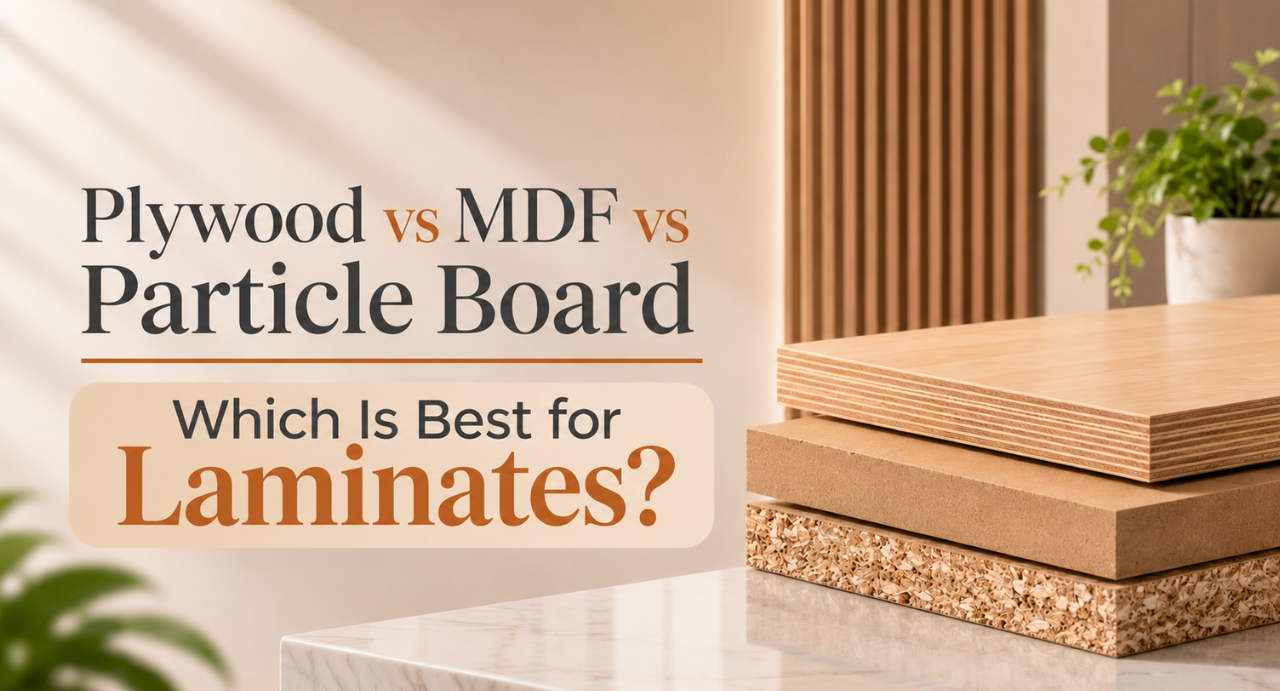
Choosing the right base material is just as important as selecting the right laminate sheet for your furniture. While decorative laminates provide the visible surface, the board underneath acts as their foundation. It influences how well the laminate bonds, how smooth the finished surface looks and how well it performs over time.
Plywood, Medium Density Fibreboard (MDF) and particle board are three commonly used substrates for applying decorative laminates. However, they differ in construction, surface quality, strength, moisture resistance and cost, which makes each suitable for different laminate applications.
So, which board is best for laminates? Let’s compare plywood, MDF and particle board to understand their differences and identify the most suitable base for different laminate applications.
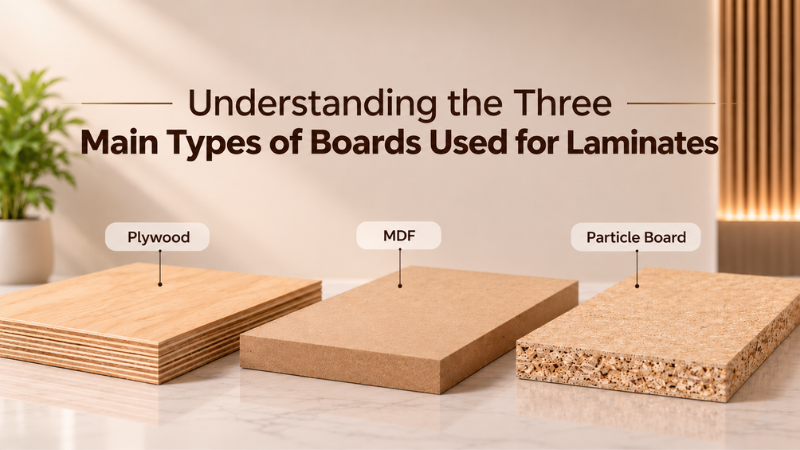
Understanding the Three Main Types of Boards Used for Laminates
Plywood, MDF and particle board are manufactured differently, and these differences affect their suitability for decorative laminate sheets. Understanding their characteristics helps in choosing the right base according to the required finish and application.
1. Plywood: A Strong and Stable Base for Laminates
Plywood is an engineered wood product manufactured by bonding multiple thin layers of wood veneer together. These layers are generally arranged with their grain directions crossing each other, creating a strong and stable board.
Its layered construction provides good structural strength and screw-holding properties, making it a suitable base for decorative laminates on furniture components that require additional support.
Key characteristics of plywood:
- Strength and Stability: Its cross-layered construction provides good structural support for surfaces finished with decorative laminates.
- Screw-Holding Capacity: Plywood generally offers good screw retention, making it suitable for applications where laminate-finished surfaces require hinges and hardware fittings.
- Different Grades: It is available in different grades, including moisture-resistant and boiling-water-resistant varieties, depending on the intended application.
- Surface Quality: The surface depends on veneer grade and manufacturing quality. Some plywood may require additional sanding or preparation before applying laminate sheets.
Common applications for decorative laminates on plywood:
- Kitchen cabinets and shutters
- Wardrobes and storage units
- Beds and bedroom furniture
- Office desks and workstations
- Shelves and other furniture surfaces
Plywood is a suitable choice when a laminate application requires a strong and stable base, particularly for surfaces that need secure hardware fixing. However, the board’s quality and surface preparation should be checked before applying decorative laminates.
2. MDF: A Smooth and Uniform Base for Laminates
Medium Density Fibreboard (MDF) is an engineered wood product manufactured by compressing fine wood fibres with resin under heat and pressure. Unlike plywood, which consists of visible veneer layers, MDF has a uniform composition throughout the board.
Its smooth and consistent surface makes it particularly suitable for decorative laminate sheets where an even finish is important.
Key characteristics of MDF:
- Smooth Surface: Its uniform composition provides a suitable base for decorative laminates, including solid-colour and high-gloss finishes.
- Consistent Thickness: MDF generally offers uniform panel thickness, supporting an even surface for laminate application.
- Easy Machining: It can be cut, shaped and routed into different profiles before applying decorative sheets.
- Moisture Sensitivity: Standard MDF can swell when exposed to moisture, particularly through unsealed edges. Moisture-resistant grades are available for applications with greater humidity exposure.
Common applications for decorative laminates on MDF:
- Wardrobe shutters
- Drawer fronts
- Decorative wall panels
- Cabinet doors
- Interior furniture surfaces
MDF is particularly useful when a smooth and uniform base is required for decorative laminates. Its surface supports a consistent finish, but exposed edges should be properly sealed and the appropriate grade should be selected according to the installation environment.
3. Particle Board: An Economical Base for Laminates
Particle board, also known as chipboard, is an engineered wood panel manufactured by compressing wood particles, chips and other wood residues with resin under heat and pressure.
It is generally more economical than plywood & MDF and is commonly used as a base for decorative laminate sheets in modular furniture and other cost-conscious applications.
Key characteristics of particle board:
- Cost-Effectiveness: It is generally an economical option for applications where decorative laminate surfaces are required at a lower material cost.
- Uniform Surface: Its manufactured structure provides a relatively consistent base for decorative finishing.
- Density Variations: It is available in different densities and thicknesses, which influence its strength and suitability for different applications.
- Limited Moisture Resistance: Standard particle board is susceptible to swelling when exposed to moisture, especially along unprotected edges.
- Hardware Fixing: Its screw-holding performance depends on board density, thickness and fixing methods. Repeated removal and refitting of screws can weaken the fixing.
Common applications for decorative laminates on particle board:
- Modular furniture carcasses
- Wardrobe interiors
- Storage cabinets
- Office desks and furniture
- Shelving and drawer components
- Event and exhibition stall panels
Particle board is a practical and economical base for decorative laminates in dry indoor environments. It is also used for temporary indoor exhibition displays, counters and other stall elements where cost is an important consideration. However, its load capacity, moisture exposure and fixing requirements should be considered before selecting it.
Plywood vs MDF vs Particle Board: Key Differences
Although plywood, MDF and particle board can all be used as bases for decorative laminates, their properties influence the quality and suitability of the finished surface. Comparing these characteristics helps identify the right substrate for different laminate applications.
| Comparison Factor | Plywood | MDF | Particle Board |
|---|---|---|---|
| Construction | Cross-layered wood veneers | Compressed wood fibres | Compressed wood particles |
| Surface quality | Depends on veneer grade | Smooth and uniform | Generally uniform |
| Structural strength | Generally high | Moderate (Depends on density and grade) | Generally lower |
| Screw-holding capacity | Generally good | Moderate (Depends on fixing method) | Depends on density and fixing method |
| Moisture resistance | Good but depends on grade | Standard MDF has limited resistance | Standard particle board has limited resistance |
| Surface preparation | May require sanding or levelling | Generally provides a smooth base | Surface should be checked for uniformity |
| Relative cost | Generally higher | Generally moderate | Generally lower |
| Common laminate applications | Cabinets, shelves and furniture surfaces | Shutters, panels and decorative surfaces | Modular furniture and storage units |
Important: These are general comparisons, not fixed performance ratings. Actual properties depend on the board’s manufacturing quality, density, thickness, grade and intended application.
Which Board Is Best for Different Laminate Applications?
The best substrate depends on the type of surface where the laminate sheet will be applied, the finish required and the conditions in which it will be used. A board that works well for a smooth decorative shutter may not be the most suitable choice for a kitchen cabinet or a heavily loaded shelf.
Let’s look at some common applications and the most suitable base materials for decorative laminates.
1. Kitchen Cabinets and Shutters
Kitchen surfaces are regularly exposed to water splashes, steam, heat and frequent cleaning. Therefore, the base material should be selected carefully before applying decorative laminates.
BWR (Boiling Water Resistant) or BWP (Boiling Water Proof) grade plywood is generally a suitable choice for kitchen cabinet structures because of its strength and moisture-resistant bonding. For kitchen shutters, MR (Moisture Resistant) MDF or HDHMR (High-Density High-Moisture Resistant) board can also be considered when a smooth and uniform base is required for laminate sheets.
The important consideration is that decorative laminates do not make the underlying board waterproof. Proper edge sealing, joints and installation are essential.
2. Wardrobes and Bedroom Furniture
Wardrobes and bedroom furniture commonly use decorative laminates on shutters, drawer fronts, shelves and storage surfaces. The choice of substrate depends on the type of surface and finish required.
Plywood is a good option for wardrobe structures, shelves and storage compartments where strength is important. MDF is often preferred for wardrobe shutters and drawer fronts because its smooth surface provides a suitable base for decorative laminate sheets.
Particle board is also a practical, economical option for wardrobe interiors and storage components where heavy loads are not expected.
3. Office Furniture and Workstations
Decorative laminates are widely used on office desks, workstations, storage cabinets and other furniture surfaces because they provide a finished appearance and are available in different colours, textures and finishes.
Plywood is a suitable base for desk surfaces and furniture components that require greater strength and secure hardware fixing. MDF works well for decorative panels, cabinet shutters and surfaces where uniformity is important. Particle board is commonly used for economical modular office furniture, provided its load-bearing requirements are met.
4. Shelves and Storage Units
The substrate used for shelves finished with decorative laminates should be selected according to the expected weight, shelf length, board thickness and distance between supports.
Plywood is generally preferred for shelves carrying heavier loads or spanning longer distances. MDF and particle board can also be used for suitable storage applications, but their thickness, density and support requirements should be considered to minimise bending or sagging.
5. Decorative Wall Panels and Furniture Surfaces
For decorative wall panels, cabinet fronts and other visible surfaces, the base material plays an important role in achieving a consistent laminate finish.
MDF provides a smooth and uniform surface for decorative laminate application, making it a preferred option for many decorative panels. Plywood can also be used when the application requires additional structural support.
Regardless of the selected board, proper surface preparation and bonding are essential for achieving a neat and consistent finish with decorative laminates.
6. Event and Exhibition Stalls
Particle boards can be a cost-effective base material for temporary indoor event stalls and exhibition setups. It is suitable for decorative laminate sheets applied to display panels, counters, shelves and other stall elements where an economical surface finish is required.
For these applications, particle board works best for display elements that do not need to carry heavy loads or withstand repeated assembly and dismantling. Plywood may be a better option for stall components requiring greater strength and durability.
Why Does the Base Material Matter When Applying Laminates?
A decorative laminate sheet needs a suitable, stable and properly prepared surface for effective bonding. The board underneath influences the quality of the laminate finish, its adhesion and the overall performance of the finished surface.
Here are some important factors to consider:
- Surface Smoothness: A flat and uniform base helps achieve an even laminate finish and reduces the possibility of surface imperfections showing through the decorative sheet.
- Structural Strength: The substrate should provide adequate support for the sunmica and the intended application, whether it is used on a cabinet shutter, shelf or work surface.
- Moisture Resistance: Different boards respond differently to moisture. Their grade, edge protection and installation conditions influence how well they perform in humid environments.
- Screw-Holding Capacity: The base material should provide suitable support for hinges, handles and other hardware fitted to furniture with decorative laminate surfaces.
- Dimensional Stability: The board should maintain its shape under normal indoor conditions to help minimise movement, swelling or warping that could affect the laminate surface.
Selecting the right substrate is therefore an important step in achieving a smooth, durable and well-finished decorative laminate surface.
Does the Choice of Board Affect Laminate Thickness?
The choice of substrate and laminate thickness are two different considerations. The board provides the base, while the laminate sheet provides the decorative and protective surface.
The laminate thickness should be selected according to the intended application, expected surface wear and product specifications. The substrate should be selected according to the required structural strength, surface quality and environmental conditions.
To understand the available thickness options and their applications, read our guide on laminate thickness and how to choose the right option.
Important Things to Check Before Applying Laminates
Selecting the right substrate is only one part of achieving a good laminate finish. The board’s condition and the preparation process also influence how well the decorative sheet bonds to the surface.
Before applying decorative laminates, consider the following:
- Board Quality: Check the grade, thickness and overall condition of the substrate.
- Surface Preparation: Ensure that the surface is flat, smooth and free from dust.
- Moisture Conditions: Avoid applying laminate sheets to damp boards or substrates that have been exposed to excessive moisture.
- Adhesive Compatibility: Use an adhesive suitable for the laminate sheet and substrate.
- Edge Protection: Ensure that exposed edges and joints receive appropriate finishing.
- Balanced Construction: Follow suitable fabrication recommendations for balancing the panel and reducing the risk of warping.
These precautions help improve laminate bonding and maintain the appearance of the decorative surface over time.
Conclusion
Plywood, MDF and particle board – all serve as a base for decorative laminates, but their suitability depends on the application and the finish required.
Plywood is generally suitable when the laminate application requires a strong and stable base. MDF is useful when a smooth and uniform surface is important, particularly for decorative shutters and panels. Particle board offers an economical alternative for suitable modular furniture, storage units and temporary display applications.
Ultimately, choosing the right substrate and pairing it with a suitable decorative HPL sheet are both important for achieving a well-finished and durable surface. Understanding how these boards differ can help you make a more informed decision when selecting a base for your next laminate application.
 Laminates Business